Facilities We Serve
Commercial lighting shaped around the building and the work inside it
Warehouse aisles, manufacturing tasks, office screens, retail storefronts, parking lots, and condominium garages do not need the same fixtures, controls, access plan, or maintenance strategy.
Business Outcomes
Improve the way the facility is lit, controlled, and maintained
A commercial lighting project should connect equipment decisions to operating cost, visual conditions, maintenance, access, and the way the property is used.
Reduce lighting energy use
Compare actual fixture wattage and operating hours, then consider controls where full output is not always required.
Improve light coverage
Address dark aisles, task areas, entrances, parking zones, rack faces, and inconsistent fixture layouts.
Support better visibility
Review glare, shadows, contrast, colour, flicker, distribution, and the viewpoint of the people using each area.
Lower maintenance demands
Reduce repeated lamp, ballast, driver, fixture, sensor, and high-access service where a planned upgrade makes sense.
Control operating hours
Use intentional zones, occupancy, daylight response, schedules, dimming, photocells, and commissioned settings.
Plan around operations
Coordinate tenants, shifts, lifts, shutdowns, stock, parking, security, weather, and phased access before work starts.
Commercial Lighting Services
From immediate repairs to full facility upgrades
Start with the problem you need to solve. The site assessment can connect that issue to the appropriate repair, installation, retrofit, control, or planning scope.
LED Retrofit Planning
Replace assumptions with a facility-specific baseline
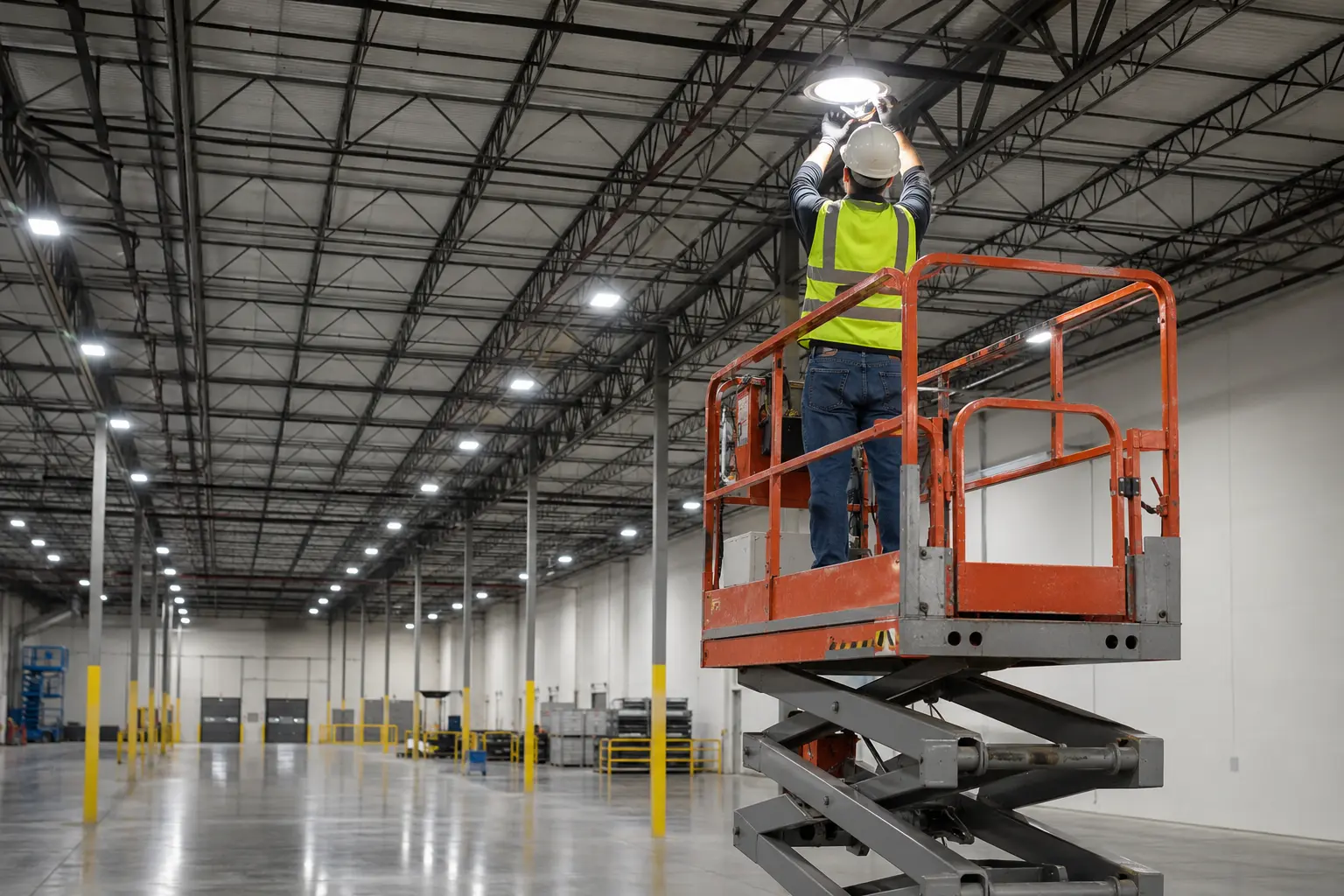
A commercial LED retrofit starts by documenting the current fixtures, wattages, operating hours, controls, failures, coverage concerns, ceiling access, and project constraints. That baseline supports a clearer comparison of fixture, retrofit, control, and implementation options.
- Existing and proposed connected load
- Annual operating-hour assumptions
- Light distribution, glare, colour, and controls
- Maintenance history and access costs
- Phasing, shutdowns, lifts, and occupied-site work
- Current incentive routes worth checking before purchase
The Main Starting Point
Request a site assessment and written estimate
The assessment turns a general concern—such as high energy use, dark aisles, failed exterior lighting, inconsistent office fixtures, or recurring service calls—into a defined project discussion.
You do not need a complete fixture schedule to get started. Tell us the facility type, priority areas, problem, operating schedule, and timing. Technical details can be collected during the review.
- Facility and representative fixture inventory
- Failed equipment and problem-area review
- Operating hours and occupancy patterns
- Controls, sensors, photocells, and schedules
- Ceiling, pole, lift, tenant, and access conditions
- Repair, retrofit, control, and phasing options
- Estimated energy impact when enough data is available
- Written scope, assumptions, exclusions, and estimate
Ontario Programs
Check incentive timing before eligible equipment is purchased
Eligible commercial lighting products, controls, and small-business projects may qualify for current Ontario programs or point-of-purchase discounts. Customer, product, purchasing channel, application, installer, pre-approval, and timing rules vary.
We can review the proposed lighting scope and identify current programs or purchasing discounts worth investigating. Eligibility and final incentive amounts are determined by the applicable program provider.
Projects
Commercial lighting across the places businesses operate
Explore warehouse, manufacturing, office, retail, parking, exterior, garage, emergency-lighting, control, installation, and maintenance project types.
Warehouse LED High-Bay Lighting
High-bay LED lighting across a large warehouse floor with practical coverage and clear service aisles.
Distribution-Centre Aisle Lighting
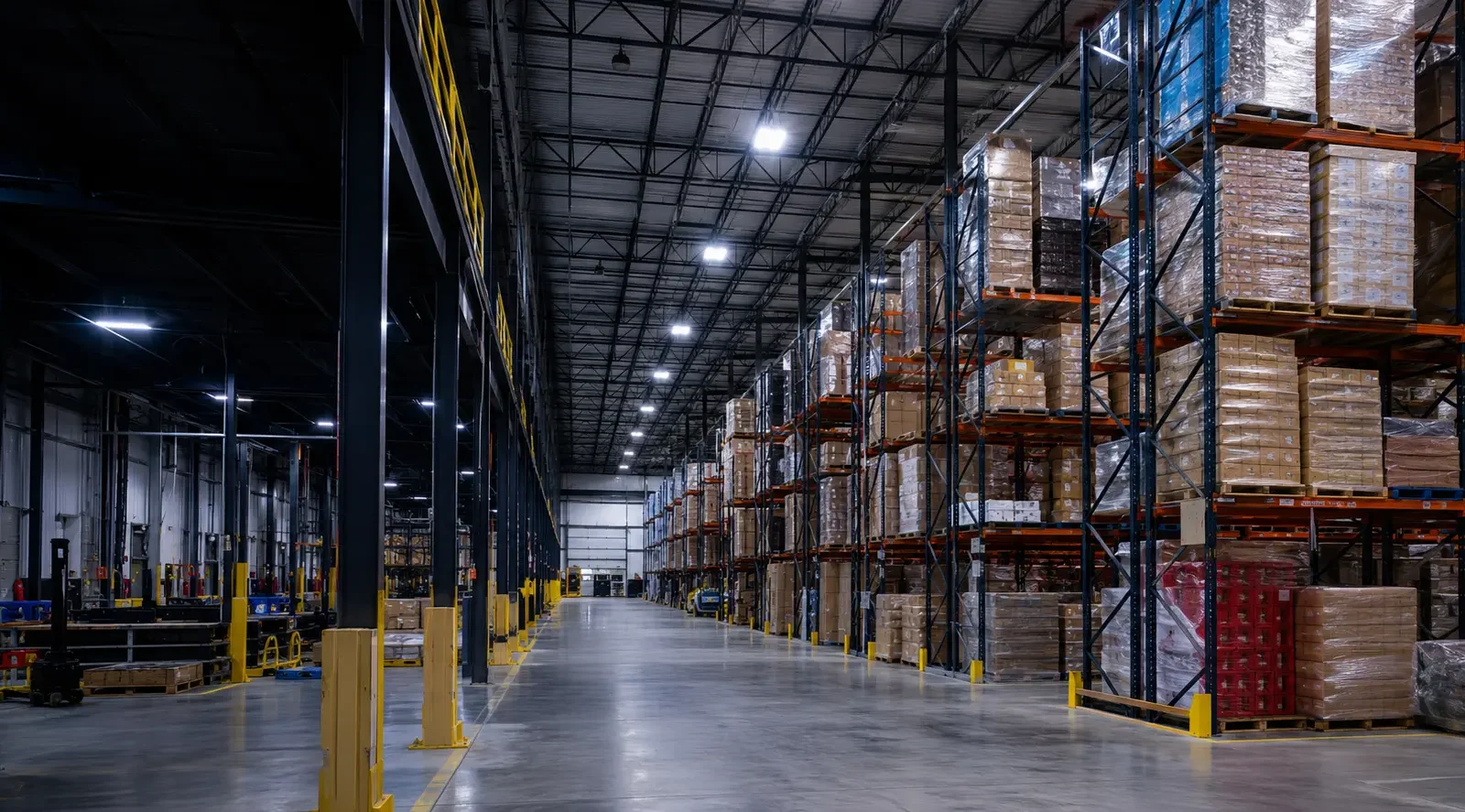
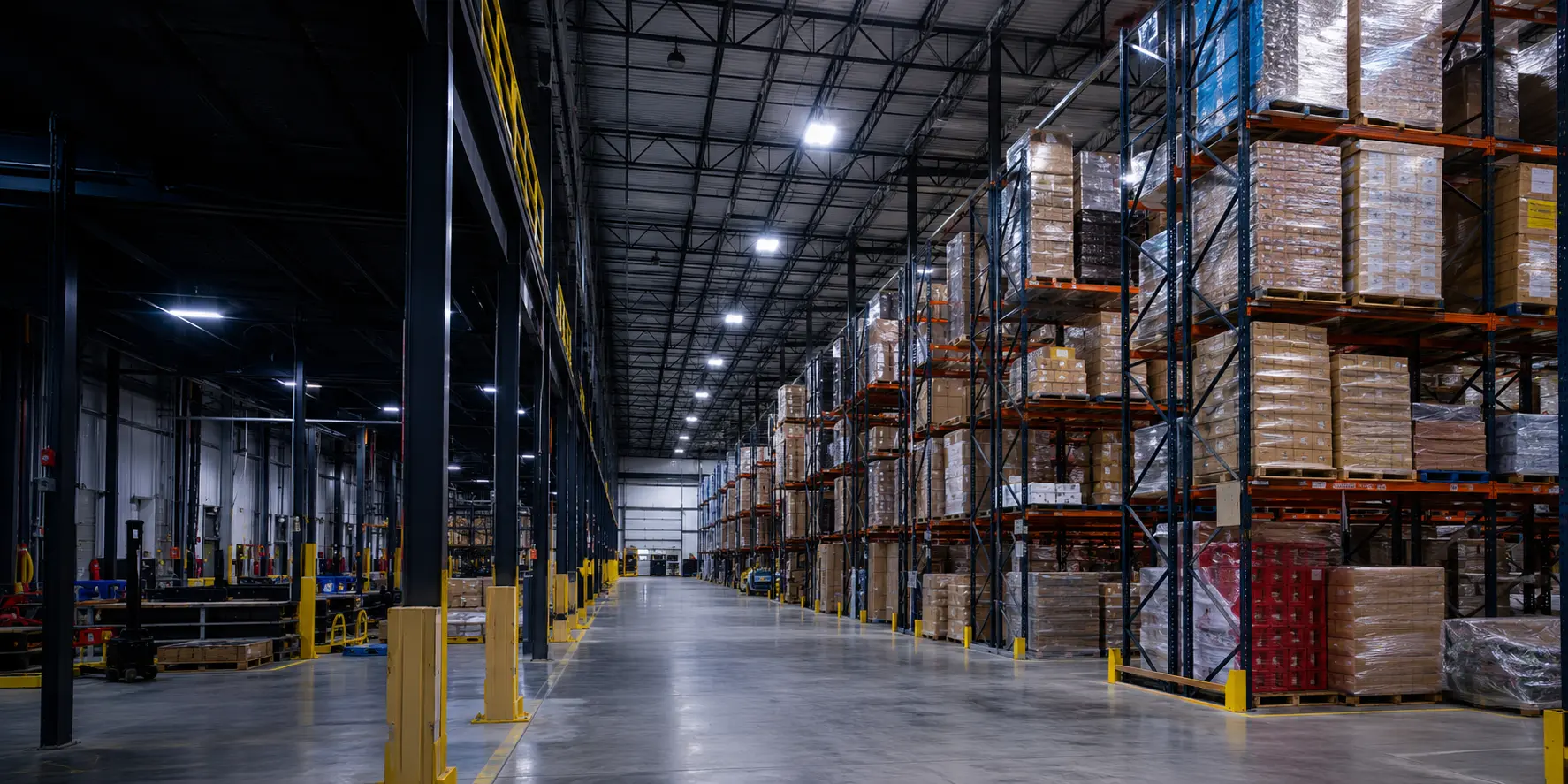
Linear aisle lighting arranged around tall pallet racking and a long distribution-centre travel route.
Manufacturing Floor Lighting
High-output industrial LED lighting across production equipment, task zones, and marked travel routes.
Office LED Panel Lighting
Uniform commercial LED panel lighting for an open office, meeting rooms, and circulation areas.
Retail Plaza Exterior Lighting
Storefront, canopy, walkway, and parking-edge lighting across a multi-tenant commercial plaza.
Commercial Parking-Lot Lighting
LED pole lighting providing practical coverage across parking stalls, drive lanes, and pedestrian approaches.
Repairs & Maintenance
Fix the immediate issue and keep the failure history useful
Commercial lighting service can cover dark, dim, flickering, cycling, or intermittent fixtures; failed drivers, lamps, and ballasts; sensor and photocell problems; parking-lot and exterior failures; emergency-lighting faults within scope; and repeated high-access work.
For the fastest preparation, send the exact location, symptom, number of fixtures, photos, ceiling or pole height, access limits, control information, and prior repair history if known.
A Clear Commercial Process
Specific recommendations without unsupported sales claims
The website is built around site conditions, defined scope, written assumptions, and current primary sources—not invented savings percentages, unverified credentials, or one-size-fits-all fixture promises.
Discuss
Start with the facility, problem, priority areas, operating conditions, timing, and the people involved in approval.
Assess
Review representative equipment, lighting conditions, controls, access, maintenance, and implementation constraints.
Define
Separate repairs, upgrades, controls, incentives, phasing, assumptions, exclusions, and customer responsibilities.
Estimate
Provide a written scope and estimate that the property or facility decision-maker can evaluate.
Frequently Asked Questions
Commercial lighting questions from facility decision-makers
What types of commercial properties do you work with?
The website is focused on warehouses, distribution centres, manufacturing facilities, offices, retail stores and plazas, commercial properties, and multi-residential buildings in Brampton. The exact scope depends on the facility, electrical work, access, and operating requirements.
What happens during a commercial lighting site assessment?
The review can document facility areas, representative fixtures, existing technology, failed equipment, light-coverage concerns, operating hours, controls, ceiling or pole access, scheduling constraints, project priorities, and information needed for a written scope and estimate.
Can lighting work be completed around business operations?
Many projects can be phased by area, aisle, floor, tenant, shift, or exterior zone. The feasible schedule depends on access, electrical isolation, lifts, occupants, production, inventory, parking, security, weather, and the work being performed.
Do all commercial LED retrofits qualify for incentives?
No. Current Ontario programs have specific customer, product, purchase-channel, installer, application, approval, and timing rules. Eligibility and final amounts are determined by the applicable program provider.
Can you repair commercial lighting without replacing the entire system?
Often, yes. Fixtures, drivers, ballasts, lamps, sensors, photocells, timers, connections, and controls may be repairable. Condition, parts, repeated failures, access cost, compatibility, and performance determine whether repair or replacement is more practical.
How are lighting energy savings estimated?
A planning estimate compares existing and proposed fixture wattage, quantity, annual operating hours, control effects, and the applicable electricity rate. Actual results depend on the final equipment, control settings, schedules, use, and site conditions.