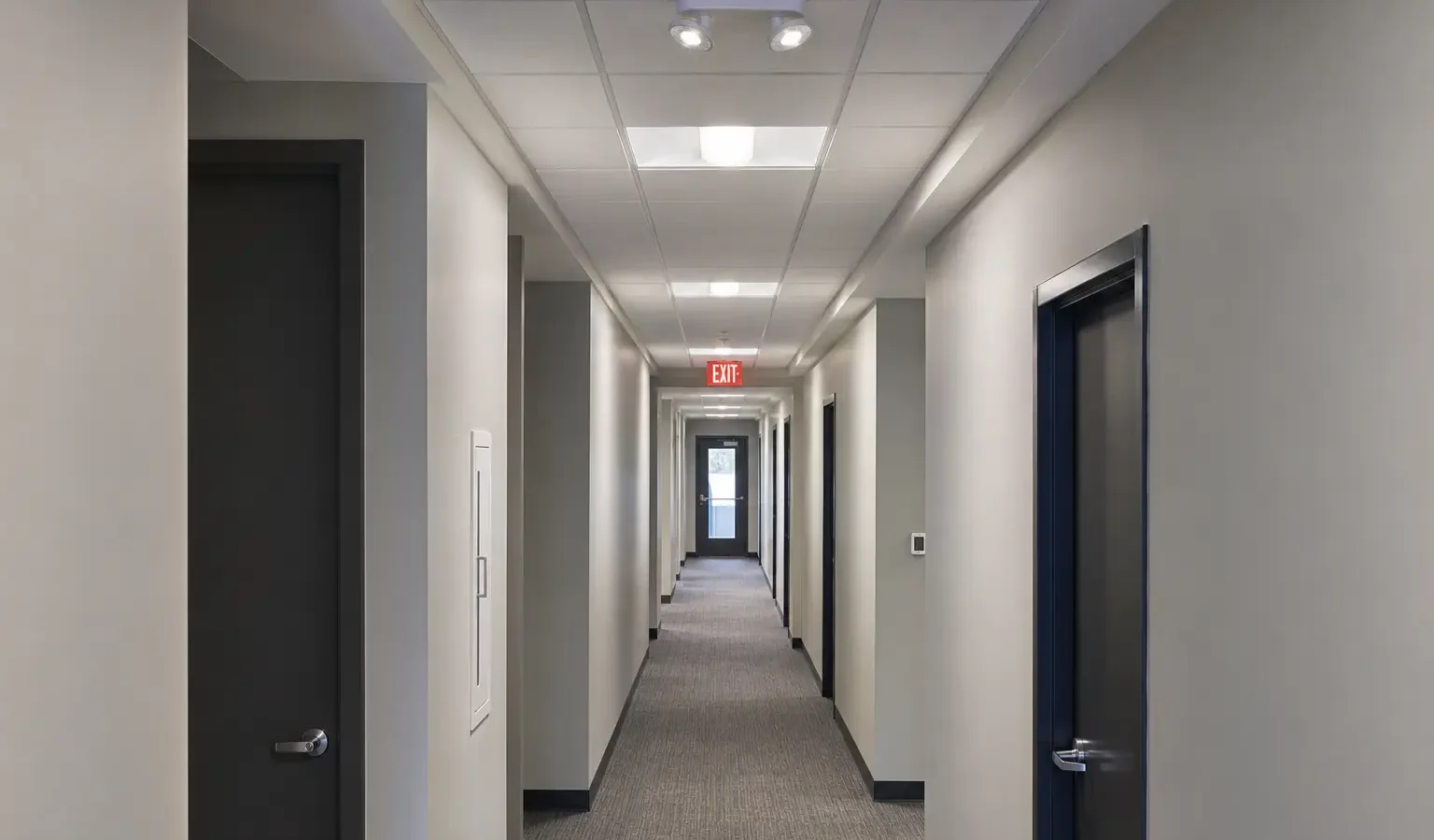
Emergency and exit lighting work focuses on the fixtures, battery units, exit signs, circuits, and defined electrical scope that support illumination during a power interruption.
A dark exit sign, failed battery unit, damaged emergency head, indicator fault, or renovated route should be reviewed promptly. The scope must stay clear: emergency-lighting electrical work is not a substitute for fire-alarm inspection, building-code consulting, or the responsibilities of the property’s designated testing provider.
Emergency and exit lighting issues
Faults may be visible during routine checks, after a power interruption, during a tenant change, or when a route is altered. Equipment age, batteries, charging components, lamps or LED boards, circuits, damage, and unsuitable placement can all affect the response.
- Exit signs or emergency heads that are dark, damaged, or intermittent
- Battery units with fault indicators, weak batteries, or charging problems
- Emergency fixtures that do not operate as expected during testing
- Renovations or layout changes that affect exits and travel routes
- Mixed, obsolete, or difficult-to-source emergency-lighting equipment
- Unclear equipment records, circuit identification, or maintenance history
Scope
Emergency and exit lighting work can include
The exact work depends on the equipment, building, applicable requirements, and the party responsible for testing and documentation.
- Exit-sign, battery-unit, emergency-head, and emergency-fixture replacement
- Troubleshooting of electrical supply, charging, battery, lamp, LED, and connection faults
- Equipment review during renovations or tenant improvements
- Coordination of circuits, mounting, access, labels, and replacement compatibility
- Defined electrical upgrades for obsolete or damaged equipment
- Coordination with property management and the applicable testing or compliance process
Site-Specific Planning
Keep the electrical scope and compliance responsibilities clear
Emergency-lighting equipment should be reviewed within the building’s broader life-safety responsibilities. The project needs accurate locations, equipment types, circuit conditions, access, testing history, and clarity about which party is responsible for inspections, logs, fire-alarm work, building-code review, and other systems outside the lighting scope.
| Planning factor | Why it matters |
|---|---|
| Equipment condition | Batteries, chargers, lamps, LED boards, heads, signs, housings, mounting, damage, and indicator status affect the repair. |
| Building changes | Partitions, tenant layouts, doors, routes, ceiling work, and occupancy changes may affect the required review. |
| Testing records | Existing logs, previous deficiencies, equipment lists, circuit records, and responsible service providers help define the issue. |
| Scope boundaries | Emergency lighting, exit signage, fire alarms, generators, code consulting, and inspections are related but distinct responsibilities. |
How the Work Is Planned
Document the fault before selecting the response
A clear process identifies the affected equipment and the parties who must be involved.
Identify Equipment
Record affected signs, units, heads, fixtures, indicators, visible condition, locations, and access.
Review the Fault
Check the defined electrical equipment and available testing, circuit, maintenance, and renovation information.
Define the Scope
Determine repair or replacement options and identify testing, code, fire-alarm, or property responsibilities outside scope.
Complete and Record
Coordinate access, complete the authorized electrical work, test the installed equipment, and provide relevant records.
Operations
Scheduling work around the facility
The affected areas may include corridors, stairs, service rooms, garages, tenant spaces, and high ceilings. Access must preserve normal routes where possible and account for occupants, security, ceiling access, and any required shutdown or testing window.
Property management should provide available equipment logs, prior deficiencies, recent renovation information, testing contacts, and access to all affected areas. If another party oversees required inspections or fire-alarm systems, responsibilities should be established before work begins.
Lifecycle Decisions
Energy, maintenance, and compliance considerations
Energy reduction is not the primary purpose of emergency and exit lighting. Equipment should be selected for its required function, approvals, compatibility, reliability, testability, and maintainability. LED equipment may reduce routine lamp replacement, but compliance and operation come first.
Electrical Safety Authority guidance explains that almost all electrical work in Ontario must be reported through a notification of work. The Licensed Electrical Contractor responsible for the electrical work normally handles the applicable notification and inspection process.
Related Work
Connect this service to the rest of the facility
Commercial lighting decisions often overlap. These related services and facility pages can help define a complete scope.
Frequently Asked Questions
Emergency and exit lighting questions
Do you service fire-alarm systems?
This page describes emergency and exit lighting electrical work. Fire-alarm inspection, monitoring, verification, and service are separate scopes and must be handled by the appropriately qualified provider.
Why is a battery-unit fault light on?
The indicator can relate to a battery, charger, lamp or head, connection, electronics, age, or another equipment condition. The unit and its documentation should be inspected rather than the indicator being ignored.
Can an old exit sign be replaced with LED equipment?
Often, but location, mounting, supply, circuit, approvals, compatibility, visibility, renovation conditions, and applicable requirements must be reviewed before a replacement is selected.
Does replacing a failed unit complete the property’s testing obligations?
Not necessarily. Repairs and replacements do not remove the owner’s other inspection, testing, recordkeeping, fire-code, or life-safety responsibilities. Confirm those obligations with the responsible providers and authorities.
Can emergency-lighting work be coordinated with an office retrofit?
Yes, but the scopes should be documented separately so emergency equipment, circuits, tests, records, and responsibilities are not obscured by the general-lighting project.
Address an emergency or exit lighting fault with a defined scope
Tell us which equipment is affected, where it is located, what testing found, and whether renovations or layout changes are involved.