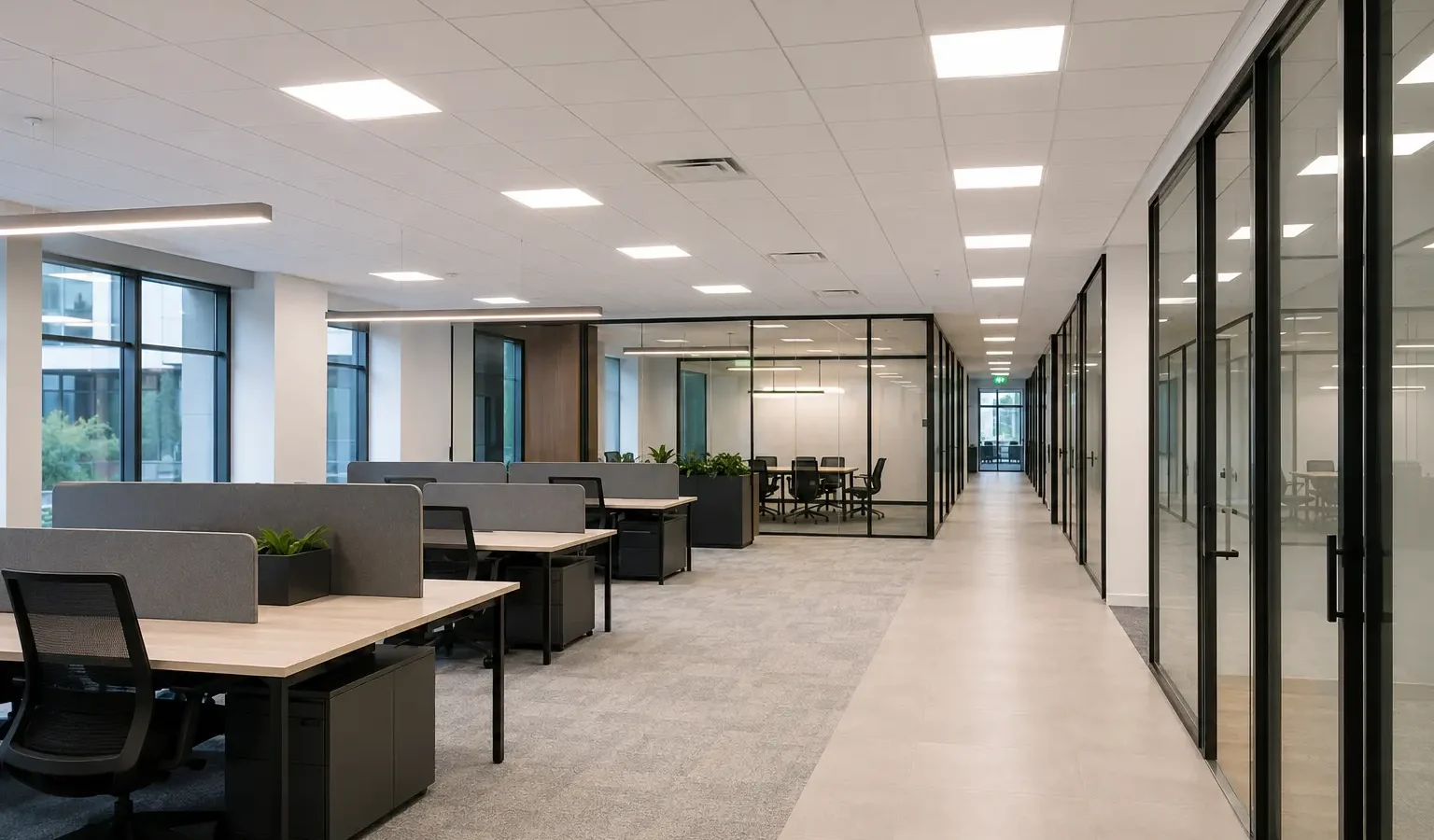
Office lighting should support screen-based work, meetings, circulation, focused tasks, and a consistent professional environment.
Panels, troffers, linear fixtures, daylight, workstation positions, partitions, ceiling conditions, colour quality, glare, and control zones all shape the office experience. An assessment can identify whether the problem is failed equipment, poor distribution, excessive output, inconsistent colour, control settings, or an outdated system.
Office lighting issues worth investigating
Office complaints are not always solved by installing brighter fixtures. Glare, contrast, flicker, mixed colour temperature, shadows, unresponsive controls, and furniture changes can make a technically bright space uncomfortable or inconsistent.
- Glare or reflections around screens and glass partitions
- Dim corridors, meeting rooms, storage areas, or workstation zones
- Yellowed lenses, failed ballasts, drivers, lamps, or panels
- Mismatched colour temperature and uneven appearance
- Lights that remain on in empty offices, rooms, and support spaces
- Renovations or furniture layouts that no longer match the fixture grid
Scope
Office lighting work can include
The scope can combine fixture upgrades, layout changes, controls, repairs, and after-hours coordination across different office areas.
- LED panels, troffers, linear fixtures, downlights, and task-area lighting
- Lighting for open offices, private offices, meeting rooms, reception, corridors, kitchens, and support rooms
- Occupancy and vacancy sensors, dimming, daylight response, and scheduling
- Replacement of failed fixtures, drivers, lenses, and controls
- Layout adjustments for renovations, ceilings, partitions, and furniture
- Phased or after-hours installation planned around employees and tenants
Site-Specific Planning
Balance visibility, comfort, and control
The office review should consider how daylight changes during the day, where screens and work surfaces are located, whether fixtures are visible in normal sightlines, and how meeting rooms or enclosed offices are used. Fixture distribution and control zoning can be more important than simply increasing output.
| Planning factor | Why it matters |
|---|---|
| Visual comfort | Glare, contrast, flicker, diffuser condition, fixture brightness, screen location, and daylight influence comfort. |
| Colour and finish | Colour temperature, colour rendering, ceiling type, wall finish, and consistent fixture appearance affect the workplace. |
| Controls | Occupancy, vacancy, dimming, daylight response, scheduling, and manual control should match how each room is used. |
| Occupied work | Furniture, sensitive equipment, employee access, dust protection, noise, lifts, and ceiling access affect scheduling. |
How the Work Is Planned
Plan office lighting room by room
A useful office scope separates open work areas from enclosed rooms, circulation, support areas, and spaces with substantial daylight.
Review Spaces
Map fixture types, room functions, ceilings, daylight, controls, complaints, failures, and recent layout changes.
Define Priorities
Identify where comfort, consistency, energy, maintenance, appearance, or control behaviour needs to improve.
Select Options
Compare suitable fixtures, lenses, colour, output, distribution, controls, and layout adjustments by area.
Coordinate Access
Plan ceiling access, furniture protection, work zones, after-hours requirements, testing, cleanup, and turnover.
Operations
Scheduling work around the facility
Office work can often be completed after hours or in phases by floor, suite, department, or room group. The plan should confirm building access, alarm and elevator procedures, furniture protection, ceiling access, noise restrictions, and the areas that employees need the next morning.
Multi-tenant buildings may also require property-management approval, tenant notices, loading arrangements, security access, and coordination with base-building specifications.
Lifecycle Decisions
Energy, maintenance, and compliance considerations
LED panels and controls may reduce energy and maintenance compared with older fluorescent systems, but the estimate should use the actual fixture schedule and operating hours. Occupancy or daylight controls should be commissioned for the room rather than left at generic settings.
Electrical Safety Authority guidance explains that almost all electrical work in Ontario must be reported through a notification of work. The Licensed Electrical Contractor responsible for the electrical work normally handles the applicable notification and inspection process.
Related Work
Connect this service to the rest of the facility
Commercial lighting decisions often overlap. These related services and facility pages can help define a complete scope.
Frequently Asked Questions
Office lighting questions
Can office lighting be upgraded after hours?
Often, yes. Building access, alarms, elevators, ceiling access, noise, furniture protection, security, cleanup, and the size of each phase must be confirmed before an after-hours schedule is promised.
What colour temperature is best for an office?
There is no universal answer. Existing finishes, daylight, task needs, desired appearance, adjacent spaces, and consistency matter. A selected colour temperature should be applied deliberately rather than mixed from room to room.
Will new LED panels reduce screen glare?
They may help when their luminance, diffuser, location, distribution, and dimming suit the workstation layout. Fixture replacement alone may not resolve glare caused by placement, reflections, contrast, or daylight.
Can meeting rooms and private offices have separate controls?
Yes. Smaller enclosed rooms are often good candidates for room-level occupancy or vacancy control, manual dimming, and scheduling, subject to the chosen system and applicable requirements.
Do all fluorescent troffers need complete replacement?
Not automatically. Fixture condition, lenses, wiring, approvals, compatibility, desired appearance, distribution, labour, and warranty responsibilities determine whether a full fixture, retrofit, or another approach is appropriate.
Improve office lighting without losing sight of the workday
Request an assessment for office fixtures, controls, glare, failed equipment, renovations, or an occupied-space LED upgrade.