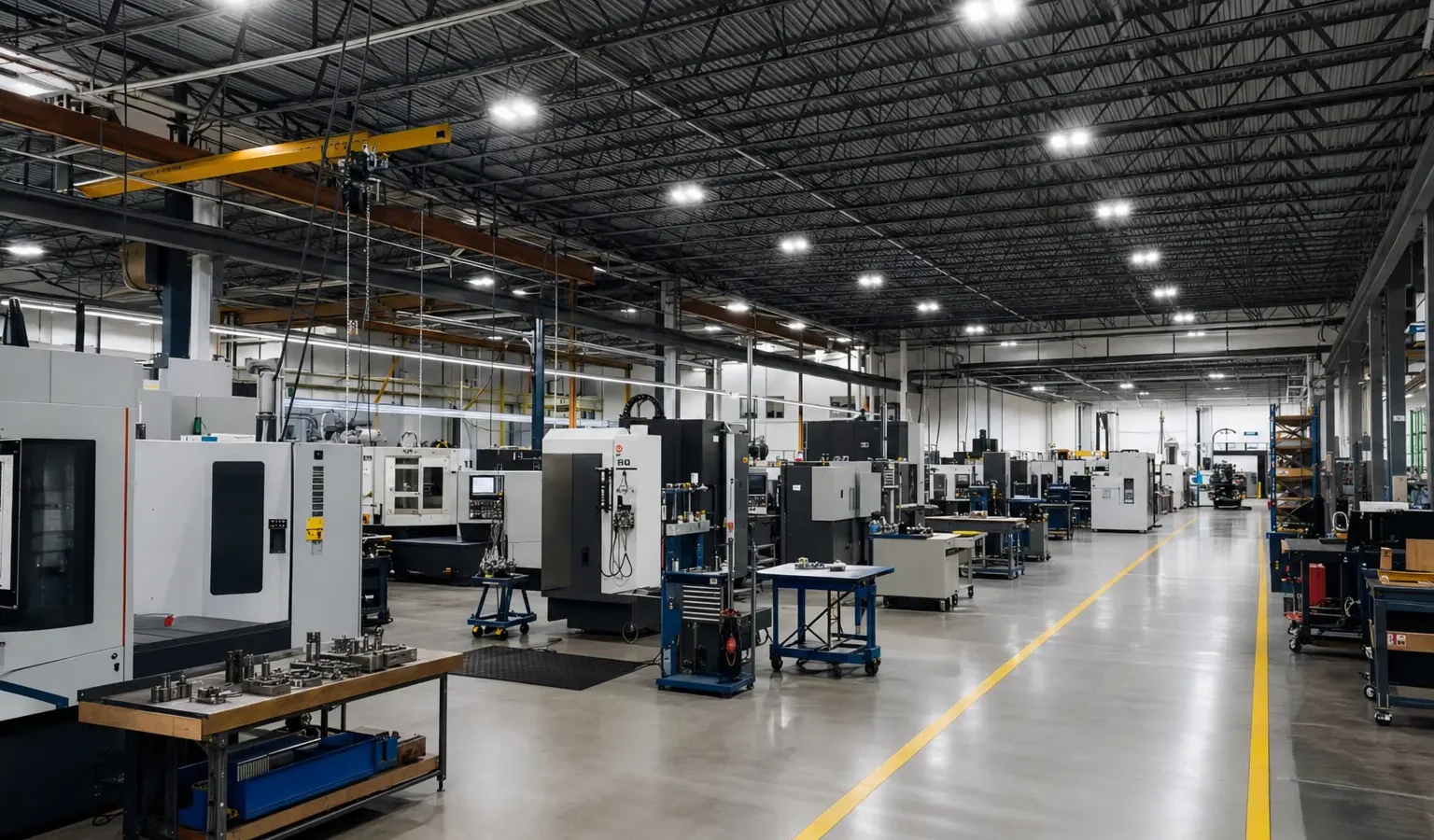
Industrial lighting must support the tasks, equipment, operating schedule, and environmental conditions of the facility.
Manufacturing and industrial spaces can combine high ceilings, equipment shadows, fine visual tasks, large open areas, heat, dust, vibration, and difficult access. The lighting plan should respond to each zone rather than treating the production floor as one uniform room.
Industrial lighting problems that need a site-specific response
Poor lighting can show up as dark machinery faces, shadowed work surfaces, glare from high-output fixtures, uneven coverage, inconsistent colour, frequent failures, or long waits for lift access. A review separates fixture problems from layout, control, maintenance, and operating issues.
- Production tasks that need clearer local or vertical illumination
- Equipment, cranes, ducts, or storage that block overhead light
- High-bay fixtures that are difficult and disruptive to service
- Legacy HID, fluorescent, or mixed lighting systems
- Areas with dust, temperature, moisture, vibration, or impact considerations
- Lighting that remains on in unoccupied zones for long periods
Scope
What industrial lighting work can include
The scope may combine general illumination, task-area lighting, controls, repairs, and access planning across different parts of the plant.
- LED high-bay and linear industrial fixtures
- Task lighting for inspection, assembly, machining, and packing areas
- Loading, receiving, storage, service, and circulation-area lighting
- Fixture and driver replacement in high-access locations
- Occupancy zones, scheduling, dimming, and networked controls
- Phased retrofits planned around shifts, equipment, and production access
Site-Specific Planning
Lighting production areas, not just floor area
An industrial assessment should document what people need to see, where shadows occur, what equipment changes the light path, and how the area is cleaned and maintained. Fixture ratings, mounting methods, optical distribution, flicker performance, colour rendering, and glare control may matter differently from one work cell to the next.
| Planning factor | Why it matters |
|---|---|
| Tasks and precision | Fine inspection, assembly, packaging, movement, and general circulation can require different lighting strategies. |
| Environment | Temperature, dust, moisture, washdown, vibration, impact, and airborne material can influence equipment selection. |
| Obstructions and height | Cranes, ducts, racking, production equipment, and high ceilings affect distribution and access. |
| Operating continuity | Shift schedules, line shutdowns, controlled zones, and material movement shape the project sequence. |
How the Work Is Planned
An industrial lighting planning process
The process should connect facility observations to equipment choices and a practical installation plan.
Map Work Zones
Identify tasks, equipment, circulation routes, loading areas, problem spots, and the current fixture arrangement.
Review Conditions
Document mounting height, environment, controls, operating hours, electrical conditions, and access limitations.
Develop Options
Compare fixture types, distributions, task-lighting needs, controls, maintenance access, and project phasing.
Coordinate Delivery
Plan safe access, lifts, shutdowns, protection, sequencing, testing, and turnover with facility operations.
Operations
Scheduling work around the facility
Industrial projects may need to align with shift changes, planned shutdowns, maintenance windows, line availability, food or process controls, and internal safety procedures. Phasing can keep portions of the facility operational while work proceeds in controlled areas.
Before work begins, the scope should define who moves materials or equipment, which areas will be isolated, how lifts travel through the facility, and whether escorts, permits, or special training are required.
Lifecycle Decisions
Energy, maintenance, and compliance considerations
Long operating hours can make wattage and control decisions especially important, but energy reduction should be estimated from actual fixture quantities, wattages, schedules, proposed controls, and electricity rates. Maintenance savings depend on the chosen equipment, environment, and access—not only rated life.
Electrical Safety Authority guidance explains that almost all electrical work in Ontario must be reported through a notification of work. The Licensed Electrical Contractor responsible for the electrical work normally handles the applicable notification and inspection process.
Related Work
Connect this service to the rest of the facility
Commercial lighting decisions often overlap. These related services and facility pages can help define a complete scope.
Frequently Asked Questions
Industrial lighting questions
What is the difference between industrial and warehouse lighting?
Warehouse lighting focuses heavily on racking, aisles, storage, loading, and high-bay distribution. Industrial lighting may also need to address machinery, task visibility, demanding environmental conditions, production continuity, and localized work areas.
Can industrial lighting be upgraded without shutting down the whole plant?
Often, yes. Work may be phased by line, bay, department, shift, or shutdown window. The feasible approach depends on access, electrical isolation, production movement, site safety rules, and the fixture layout.
Are all high-bay fixtures suitable for manufacturing areas?
No. Output, distribution, glare, flicker, temperature rating, environmental rating, impact exposure, mounting, controls, and maintainability should be matched to the actual application.
Can controls work in an industrial facility?
Yes, when the controls are selected and commissioned for the space. Occupancy patterns, sensor mounting height, obstructions, process movement, daylight, network requirements, and safe failure behaviour all need to be considered.
How are energy savings estimated?
A useful estimate compares existing and proposed connected wattage, fixture quantities, operating hours, control effects, and the applicable electricity rate. Verified bills and schedules improve the estimate.
Review your industrial lighting by area and task
A site assessment can document the production floor, problem areas, access constraints, operating schedule, and practical lighting options.