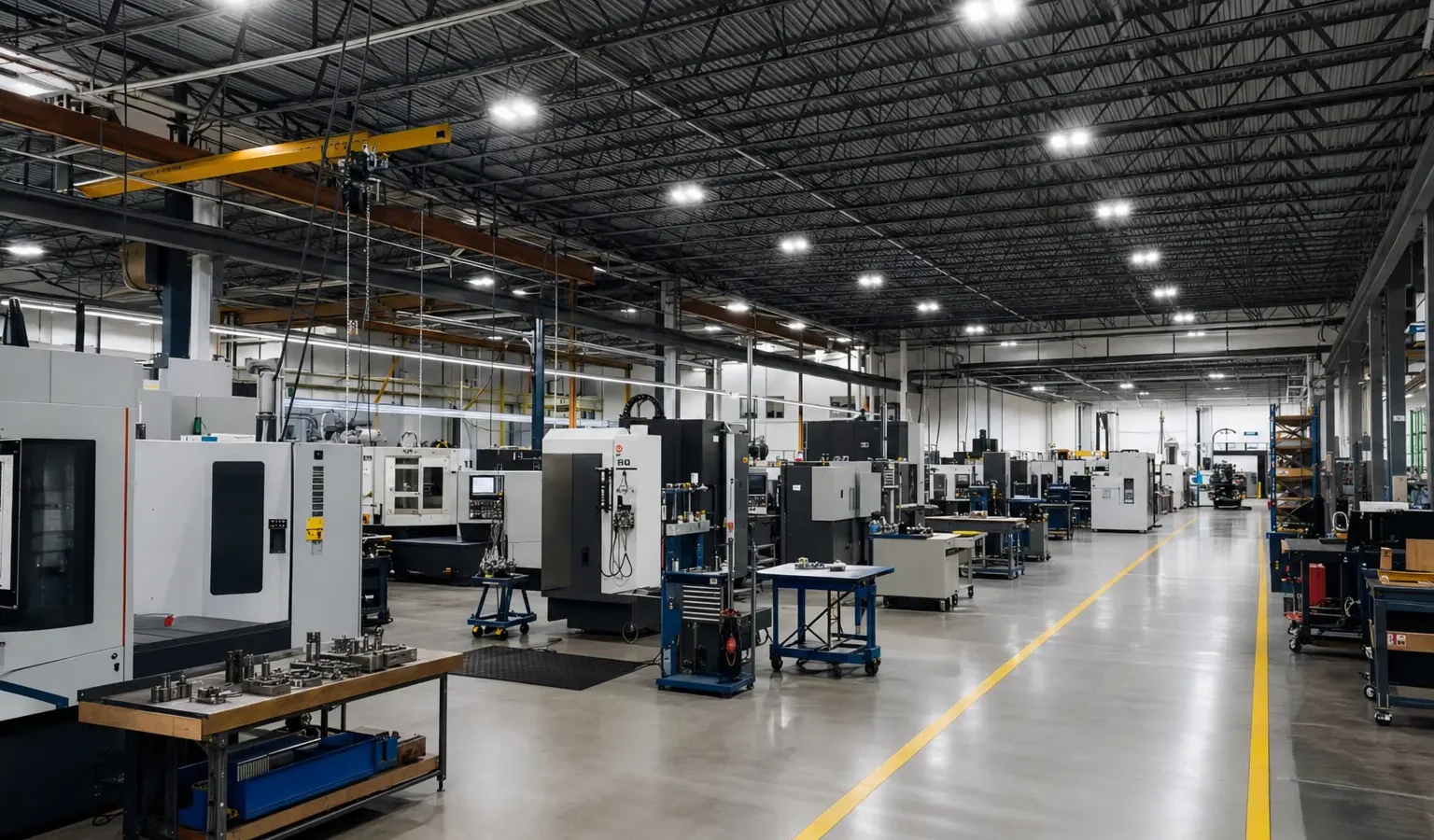
Manufacturing lighting should be planned around the work performed, equipment, environment, shift schedule, and maintenance access in each production zone.
Production floors can combine close inspection, machining, assembly, packaging, raw materials, finished goods, loading, cranes, mezzanines, and support rooms. General overhead lighting must work with task-area needs and avoid shadows or glare created by equipment and movement.
Manufacturing lighting challenges
Industrial environments introduce constraints that may not exist in a typical office or warehouse, including equipment geometry, process requirements, environmental exposure, and limited shutdown windows.
- Fine tasks or inspection points that need localized visibility
- Machinery, cranes, ducts, guards, and process equipment that block overhead light
- Heat, cold, dust, moisture, vibration, impact, oils, or washdown conditions
- High-bay failures that interrupt production or require controlled access
- Shift operations and production lines that cannot be unavailable for long periods
- Controls that must respond to people and zones without interfering with the process
Facility Zones
Separate general lighting from task and process needs
The lighting approach changes as visual tasks, obstructions, environment, and operating continuity change.
Priorities
Support production without creating a maintenance burden
A practical plan considers visibility, reliability, access, controls, energy, and the cost of interrupting work.
- Identify the actual visual task and worker viewpoint in each priority area
- Select suitable equipment for the environment, mounting, controls, and maintenance access
- Reduce dark equipment faces, sharp contrast, distracting glare, and inconsistent lighting
- Coordinate shutdowns, lifts, permits, escorts, line clearance, and safe work zones
- Document fixtures and controls so future repairs do not restart the investigation
Implementation
Plan access and scheduling before equipment arrives
Manufacturing projects may need to align with planned shutdowns, sanitation cycles, maintenance windows, shift changes, quality requirements, controlled areas, and production clearance. The scope should identify customer responsibilities for equipment, material, process, and safety coordination.
Reliability depends on the fixture, driver, environment, thermal conditions, mounting, controls, cleaning, and electrical conditions. Maintenance planning should group high-access work where practical and keep records of equipment families, locations, and recurring failures.
Assessment Process
Build the lighting plan around production
The assessment combines operational input from the facility with technical observations in each work zone.
Review Tasks
Identify production, inspection, movement, loading, support, and problem areas with the people who use them.
Document Conditions
Record fixtures, mounting, environment, obstructions, controls, failures, access, shifts, and shutdown constraints.
Develop Options
Compare general and task lighting, fixtures, distributions, controls, ratings, maintenance, energy, and phasing.
Coordinate Delivery
Plan permits, escorts, line clearance, lifts, protection, shutdowns, installation, commissioning, and records.
Relevant Services
Connect the facility plan to the right lighting work
Frequently Asked Questions
Manufacturing lighting questions
Can task lighting be added without replacing all overhead fixtures?
Possibly. A focused task-lighting solution may complement suitable general lighting, subject to equipment, mounting, glare, shadows, environment, cleaning, wiring, controls, and safe placement.
How do you light around large machinery?
Review the task, worker viewpoint, equipment geometry, guards, shadows, moving parts, access, local mounting options, environment, and maintenance. More overhead output may not reach the required surface.
Can production continue during an LED retrofit?
It may continue in unaffected zones when phasing, electrical isolation, lifts, work-zone control, material movement, process requirements, and safe lighting are properly coordinated.
Are there industrial fixtures for dust or washdown areas?
There are fixtures designed for various environmental conditions, but the actual dust, moisture, washdown, corrosion, temperature, impact, classification, approvals, and cleaning method must be defined before selection.
How do controls work around production processes?
Controls should be based on occupancy and process requirements, not merely movement. Critical zones, safe light levels, timeouts, schedules, overrides, sensor coverage, equipment motion, and failure behaviour require careful commissioning.
Review manufacturing lighting at the task level
Tell us about the production areas, visual tasks, equipment, environment, shifts, access, and recurring lighting problems.