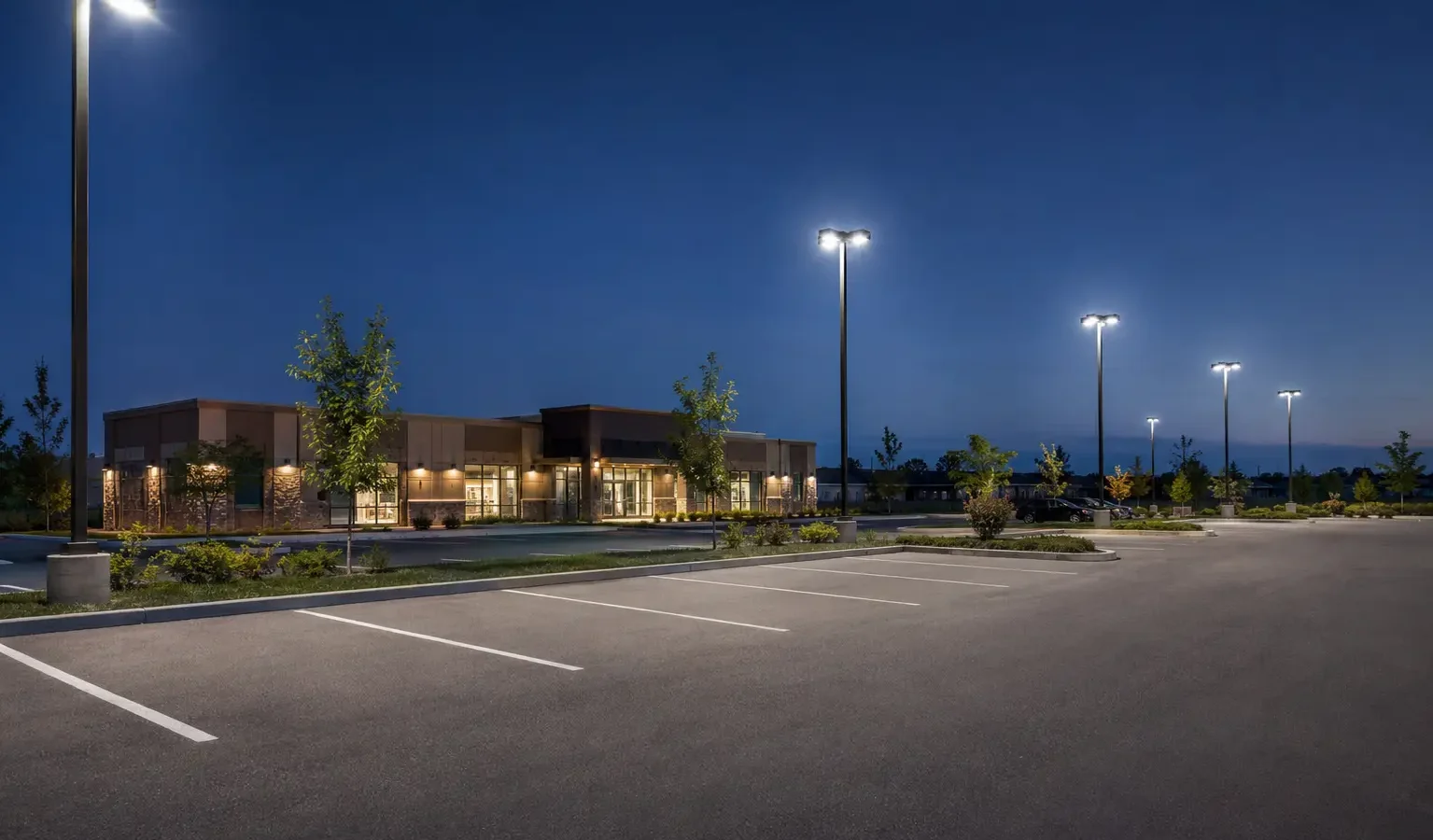
Parking-lot lighting should provide practical coverage for vehicle and pedestrian areas while controlling glare, spill light, operating hours, and maintenance access.
A failed pole fixture is visible, but the underlying issue may involve a driver, wiring, contactor, photocell, timer, underground circuit, pole condition, or control schedule. When coverage is poor across the site, fixture distribution, pole spacing, mounting height, trees, building shadows, and the approved site conditions also need review.
Parking-lot lighting issues to investigate
Exterior lighting changes with weather, landscaping, pavement use, adjacent development, and equipment age. A night review can reveal dark zones, glare, inconsistent colour, failed controls, and areas where a simple lamp or fixture replacement will not solve the pattern.
- One or more pole fixtures that are dark, cycling, or intermittent
- Uneven coverage between parking stalls, walkways, entrances, and drive lanes
- Glare directed toward drivers, pedestrians, neighbouring properties, or residential areas
- Photocells, timers, contactors, or schedules that operate incorrectly
- Legacy HID fixtures with colour shift, slow restart, or recurring maintenance
- Tree growth, building changes, or property layouts that obstruct existing light
Scope
Parking-lot lighting work can include
The scope may focus on individual repairs, a control problem, a planned LED upgrade, or the broader performance of the parking area.
- LED pole-head and area-fixture replacement
- Driver, component, connection, photocell, timer, and control troubleshooting
- Review of dark areas, glare, shielding, direction, distribution, and obstructions
- High-access equipment planning and controlled work zones
- Phased retrofit options for multiple poles or property areas
- Maintenance planning for plazas, offices, industrial sites, and multi-residential properties
Site-Specific Planning
Evaluate the parking lot after dark
Daytime inspection can document poles and equipment, but a night review helps show actual coverage, glare, outages, control timing, and transitions between parking areas, walkways, and entrances. Any proposed changes should also consider the approved site plan and neighbouring land uses.
| Planning factor | Why it matters |
|---|---|
| Coverage | Pole spacing, height, distribution, pavement, buildings, landscaping, and fixture aiming influence where light reaches. |
| Glare and spill | Shielding, optics, tilt, output, neighbouring properties, roadway views, and residential zones affect light direction. |
| Controls | Photocells, astronomical clocks, timers, contactors, network schedules, and manual overrides determine operating hours. |
| Access and assets | Pole condition, handholes, circuits, underground feeds, lift access, traffic control, and parking occupancy affect work. |
How the Work Is Planned
From outage review to a parking-lot plan
The right path depends on whether the property has an isolated failure, control issue, repeated maintenance problem, or broader coverage concern.
Inspect the Site
Document poles, fixtures, controls, outages, visible condition, access, traffic, landscaping, and affected areas.
Review at Night
Where practical, observe actual operation, dark zones, glare, transitions, timing, and neighbouring impacts.
Define the Work
Separate repairs from fixture upgrades, control changes, electrical investigation, and broader design questions.
Coordinate Access
Plan lifts, parking closures, traffic and pedestrian routes, weather, testing, and phased completion.
Operations
Scheduling work around the facility
Pole and area-light work requires enough space for the selected access equipment and a controlled zone around it. Parking occupancy, deliveries, snow storage, traffic flow, pedestrian routes, landscaping, and weather can affect the schedule.
Property management should identify circuits, control locations, known underground issues, pole records, prior repairs, tenant concerns, and any areas where access cannot be interrupted.
Lifecycle Decisions
Energy, maintenance, and compliance considerations
LED pole fixtures and suitable controls may reduce connected load and recurring lamp or ballast work, but fixture selection should preserve useful distribution. Brampton property standards also address exterior lighting direction and maintenance; changes should be reviewed against the actual property and applicable requirements.
Electrical Safety Authority guidance explains that almost all electrical work in Ontario must be reported through a notification of work. The Licensed Electrical Contractor responsible for the electrical work normally handles the applicable notification and inspection process.
Related Work
Connect this service to the rest of the facility
Commercial lighting decisions often overlap. These related services and facility pages can help define a complete scope.
Frequently Asked Questions
Parking-lot lighting questions
Can one failed parking-lot light be repaired?
Often, yes, but the fault may be in the fixture, driver, lamp, connection, pole wiring, photocell, contactor, timer, underground circuit, or power supply. Safe access and testing are needed to diagnose it.
Why is a parking lot dark even when every fixture works?
Fixture distribution, pole spacing, mounting height, output, shielding, trees, building shadows, pavement conditions, and property changes can create dark areas. Higher output alone may increase glare without correcting the pattern.
Can parking-lot lights use photocells and timers together?
Yes, depending on the control design. Photocells, astronomical clocks, timers, contactors, scheduling, and manual overrides can be combined, but the sequence and failure behaviour should be clearly understood.
Do parking stalls need to be closed during service?
A controlled work zone is normally needed around lifts and the pole being serviced. The number of affected stalls and timing depend on access equipment, traffic, pedestrians, pole location, and the work being performed.
Can existing poles be reused for LED fixtures?
Possibly. Pole and arm condition, mounting, wind-loading considerations, wiring, access, fixture weight, distribution, controls, and the broader site plan need to be reviewed before reuse is assumed.
Bring the parking-lot problem into view
Request a review for failed poles, dark areas, glare, controls, repeated maintenance, or a planned commercial LED upgrade.
Primary Sources
Sources used for electrical, workplace, local, and incentive guidance
These primary sources support the material factual details on this page. Program information was reviewed July 24, 2026 and should be rechecked before a purchase, application, approval, or installation decision.
- Electrical Safety Authority: Notifications and InspectionsOntario guidance on notifications of work, inspections, and Licensed Electrical Contractors.
- Canadian Centre for Occupational Health and Safety: Lighting ErgonomicsWorkplace guidance on visibility, glare, shadows, contrast, task lighting, and fixture distribution.
- City of Brampton Property Standards By-law 165-2022Local requirements for commercial and industrial exterior-light direction and maintenance.