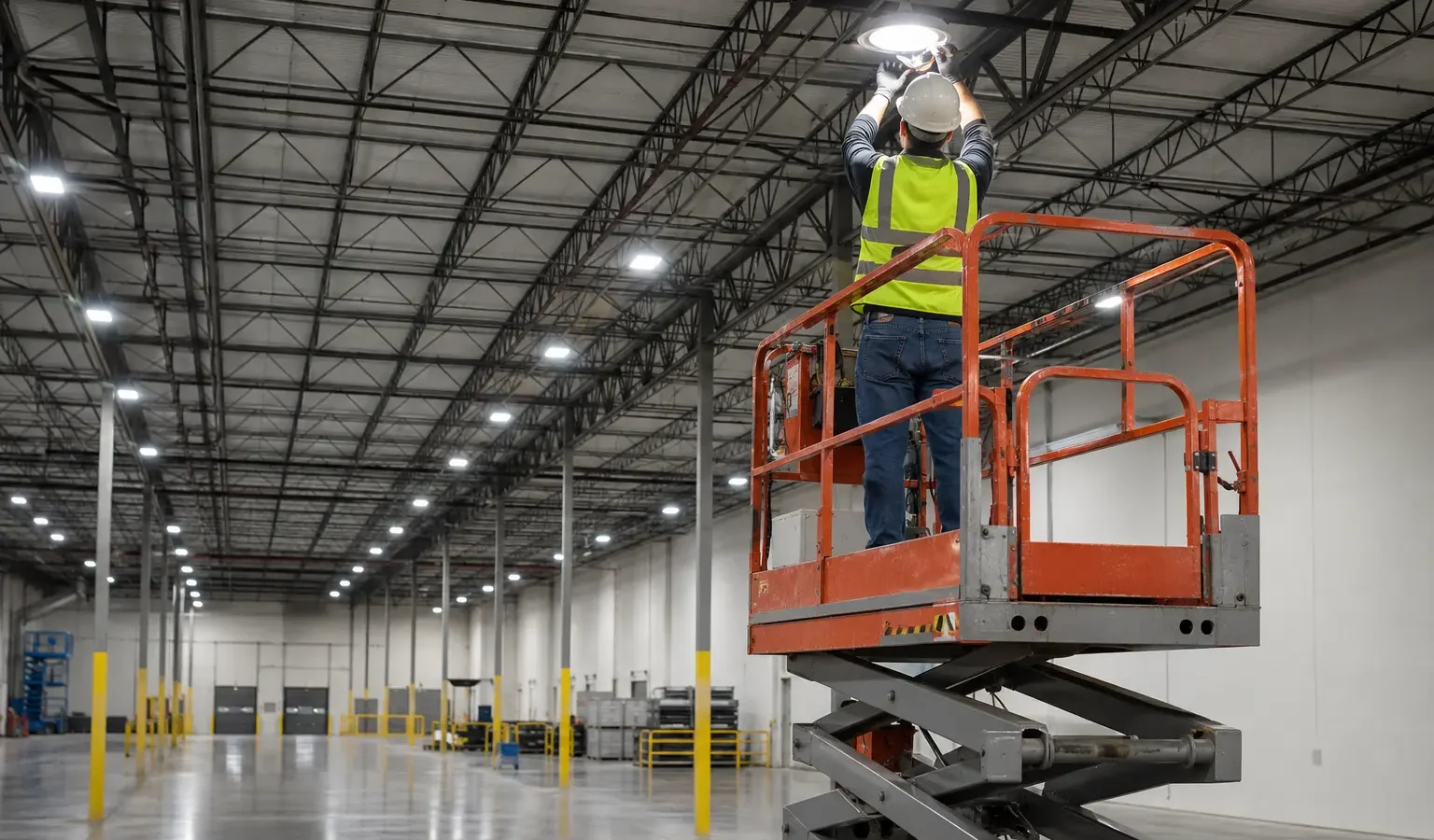
Commercial lighting repair should identify the actual fault, restore the affected area, and determine whether recurring failures point to a larger equipment or maintenance issue.
A dark fixture may have a failed lamp, driver, ballast, connection, sensor, control, circuit, or power issue. Exterior and high-bay problems also involve weather and access. Clear photos, locations, fixture information, failure patterns, and access details help prepare the service request.
Commercial lighting faults we can review
Repairs can be isolated or part of a recurring pattern. A useful service record distinguishes symptoms from verified causes and helps property managers decide when continuing repairs no longer makes sense.
- Dark, dim, flickering, cycling, or intermittent fixtures
- Failed LED drivers, fluorescent ballasts, lamps, lenses, or fixture components
- Occupancy sensors, photocells, timers, schedules, or switches that behave incorrectly
- Parking-lot poles, wall packs, high-bays, and other difficult-access fixtures
- Emergency or exit lighting faults within the defined electrical scope
- Repeated failures, mixed replacements, obsolete parts, or multi-site maintenance needs
Scope
Repair and maintenance work can include
The service may involve one location, a deficiency list, a planned maintenance visit, or recurring support across several properties.
- Fixture, driver, ballast, lamp, socket, connection, and component troubleshooting
- Sensor, photocell, time-clock, contactor, schedule, and basic control faults
- Interior, exterior, parking-lot, high-bay, office, retail, and common-area repairs
- Lift-access planning and grouped high-access maintenance
- Fixture identification, condition notes, repair records, and replacement recommendations
- Planned inspections and maintenance grouping for one or multiple properties
Site-Specific Planning
Give the service request enough context
Good repair information includes the exact area, symptom, when the problem occurs, how many fixtures are affected, ceiling or pole height, access restrictions, existing controls, available photos, and whether the equipment has failed before. This helps determine parts, access equipment, and diagnostic time.
| Planning factor | Why it matters |
|---|---|
| Symptom and pattern | Dark, flickering, cycling, dim, delayed, intermittent, weather-related, and control-related faults point to different checks. |
| Equipment | Fixture type, lamp, driver, ballast, sensor, control, approval marks, age, model information, and available parts affect repair. |
| Access | Ceiling height, pole location, lift route, floor conditions, aisle clearance, parking, tenant hours, and work-zone control affect service. |
| Repair versus replace | Condition, parts, labour, access cost, efficiency, compatibility, consistency, future maintenance, and warranty affect the recommendation. |
How the Work Is Planned
Turn recurring service calls into useful records
A consistent service process helps distinguish isolated failures from equipment that should be grouped into a larger upgrade.
Collect Details
Record location, symptom, quantity, timing, photos, height, access, controls, history, and any site restrictions.
Inspect and Test
Confirm the affected equipment and investigate the defined fixture, component, connection, control, or circuit issue.
Repair or Recommend
Complete authorized repairs where practical or document replacement and upgrade options when repair is unsuitable.
Record the Result
Identify completed work, remaining deficiencies, parts, recurring patterns, and next maintenance priorities.
Operations
Scheduling work around the facility
Service work may need tenant access, escorts, lift delivery, aisle or parking closures, equipment shutdowns, after-hours entry, or weather planning. Grouping known high-access issues into one visit can reduce repeated disruption and mobilization.
For multiple properties, a consistent request format and fixture record can improve triage. The property manager should identify site contacts, access windows, approvals, parking, security, billing, and how urgent or tenant-facing issues are prioritized.
Lifecycle Decisions
Energy, maintenance, and compliance considerations
Repair is appropriate when it restores suitable equipment economically and safely. When failures are frequent, parts are obsolete, fixtures are mismatched, or access dominates cost, a planned LED or controls upgrade may be more practical than repeated spot repairs.
Electrical Safety Authority guidance explains that almost all electrical work in Ontario must be reported through a notification of work. The Licensed Electrical Contractor responsible for the electrical work normally handles the applicable notification and inspection process.
Related Work
Connect this service to the rest of the facility
Commercial lighting decisions often overlap. These related services and facility pages can help define a complete scope.
Frequently Asked Questions
Commercial lighting repair questions
What information should I send with a repair request?
Provide the property, exact area, symptom, number of affected fixtures, when it occurs, ceiling or pole height, access restrictions, control information, photos, and any known model or previous repair details.
Can a flickering LED fixture be repaired?
Possibly. The cause may involve a driver, module, connection, control, dimming compatibility, temperature, voltage condition, or the fixture itself. Diagnosis and parts availability determine the practical response.
Do you repair high-bay and parking-lot fixtures?
The scope can include high-access interior and exterior fixtures when suitable access equipment, work-zone control, weather, site conditions, and the electrical issue are accounted for in the service plan.
When should fixtures be replaced instead of repaired?
Replacement may be more practical when parts are obsolete, failures repeat, fixtures are in poor condition, access is costly, performance is inadequate, efficiency is poor, or the property needs a consistent specification.
Can maintenance be planned across multiple properties?
Yes. A multi-site program can use consistent request information, grouped deficiencies, fixture records, access notes, priorities, and periodic visits. The exact service arrangement depends on the properties and operating requirements.
Request commercial lighting service
Send the location, symptom, access details, and photos if available. We can use that information to prepare for the repair or maintenance visit.
Primary Sources
Sources used for electrical, workplace, local, and incentive guidance
These primary sources support the material factual details on this page. Program information was reviewed July 24, 2026 and should be rechecked before a purchase, application, approval, or installation decision.
- Electrical Safety Authority: Notifications and InspectionsOntario guidance on notifications of work, inspections, and Licensed Electrical Contractors.
- Canadian Centre for Occupational Health and Safety: Lighting ErgonomicsWorkplace guidance on visibility, glare, shadows, contrast, task lighting, and fixture distribution.