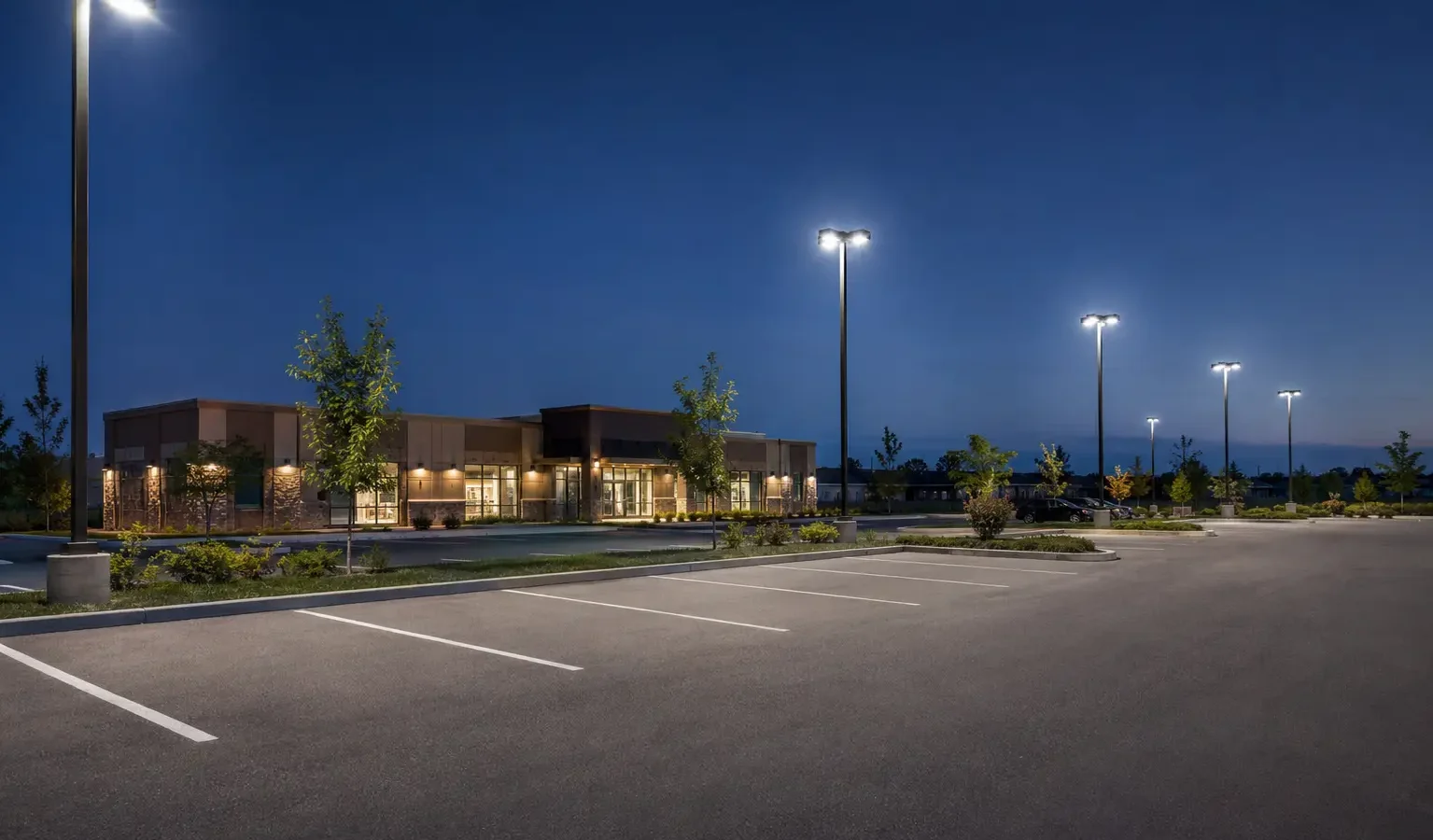
To address a dark commercial parking area, first determine whether the issue is a failed fixture or circuit, poor distribution, insufficient pole placement, glare, an obstruction, incorrect controls, or a site condition that changed after installation.
Installing a brighter pole head without diagnosing the pattern can create more glare while leaving the ground, walkway, or property edge uneven. A daytime equipment review and night observation provide different evidence.
Quick planning checklist
- Identify exact dark zones, affected routes, times, and whether the condition is new
- Check each fixture, pole, arm, mounting, tilt, lens, driver, wiring, circuit, and control status
- Observe coverage, glare, shadows, transitions, and light beyond the property after dark
- Review trees, snow storage, signs, buildings, parked vehicles, layout changes, and neighbouring uses
- Confirm photocells, timers, astronomical schedules, contactors, overrides, and dimming
- Plan lifts, parking closures, traffic, pedestrians, weather, aiming, testing, and follow-up
Start by confirming whether equipment has failed
A dark zone may come from a completely failed fixture, reduced output, cycling, a driver, a lamp, a loose connection, pole wiring, a circuit, a contactor, a photocell, a timer, or an underground issue. Record when and how the failure occurs before changing the layout.
Observe the property after dark
A night review shows where light reaches, how glare affects drivers and pedestrians, whether poles operate at the same time, how entrances and walkways transition, and whether adjacent properties receive unwanted light. Photographs should capture both the dark area and surrounding fixtures.
Separate output from distribution
Fixture lumens do not describe where the light goes. Pole height, arm, mounting, tilt, optics, cutoff, shielding, spacing, pavement, landscaping, building geometry, and obstructions shape the pattern. A fixture with the wrong distribution can waste output outside the priority area.
Review controls and operating schedules
Photocells can be affected by position, contamination, damage, or nearby light. Time clocks and network schedules can drift or be overridden. Contactors, control circuits, dimming, and manual switches can create partial or inconsistent operation. Confirm the intended sequence before replacing devices.
Consider site changes and neighbours
Trees grow, parking layouts change, additions create shadows, snow is stored near poles, and nearby development changes sightlines. Exterior changes must also consider light direction, glare, property boundaries, residential zones, approved site conditions, and applicable Brampton requirements.
Plan access and verification
Pole service needs a suitable lift or bucket access, controlled parking stalls, traffic and pedestrian separation, weather, ground conditions, overhead clearance, and electrical investigation. After repair or replacement, confirm night operation, controls, aiming, and the original dark zone.
Questions to ask before approving the work
- Is the problem a verified equipment failure or a broader coverage issue?
- Was the property observed at night with all intended controls operating?
- How do pole height, spacing, distribution, tilt, shielding, trees, and buildings affect the area?
- Are glare and light directed beyond the site being considered?
- What parking, lift, traffic, weather, and underground assumptions affect the work?
- How will the result be checked after dark?
Related services and facility guidance
Frequently asked questions
Will a higher-output LED fixture eliminate every dark area?
No. Distribution, pole spacing, mounting, tilt, shielding, obstructions, buildings, pavement, trees, and glare determine where light reaches. More output can worsen visual comfort.
Why does a pole light cycle on and off?
Possible causes include an HID lamp or ballast, LED driver, thermal condition, photocell, connection, voltage issue, control, or fixture fault. The pattern and equipment need diagnosis.
Can trees be the cause of dark areas?
Yes. Tree canopy and landscaping can block light or change the pattern over time. The response may involve maintenance, fixture selection, position, distribution, shielding, or broader site planning.
Do parking lights need to be tested after dark?
Night verification is valuable for confirming operation, coverage, glare, transitions, aiming, and control timing. Physical work can still be scheduled during safer daylight conditions.
Primary Sources
Sources used for electrical, workplace, local, and incentive guidance
These primary sources support the material factual details on this page. Program information was reviewed July 24, 2026 and should be rechecked before a purchase, application, approval, or installation decision.
- Electrical Safety Authority: Notifications and InspectionsOntario guidance on notifications of work, inspections, and Licensed Electrical Contractors.
- Canadian Centre for Occupational Health and Safety: Lighting ErgonomicsWorkplace guidance on visibility, glare, shadows, contrast, task lighting, and fixture distribution.
- City of Brampton Property Standards By-law 165-2022Local requirements for commercial and industrial exterior-light direction and maintenance.
Turn the guide into a site-specific plan
Use the facility, operating schedule, existing equipment, access, and priority areas to prepare a clear scope and written estimate.