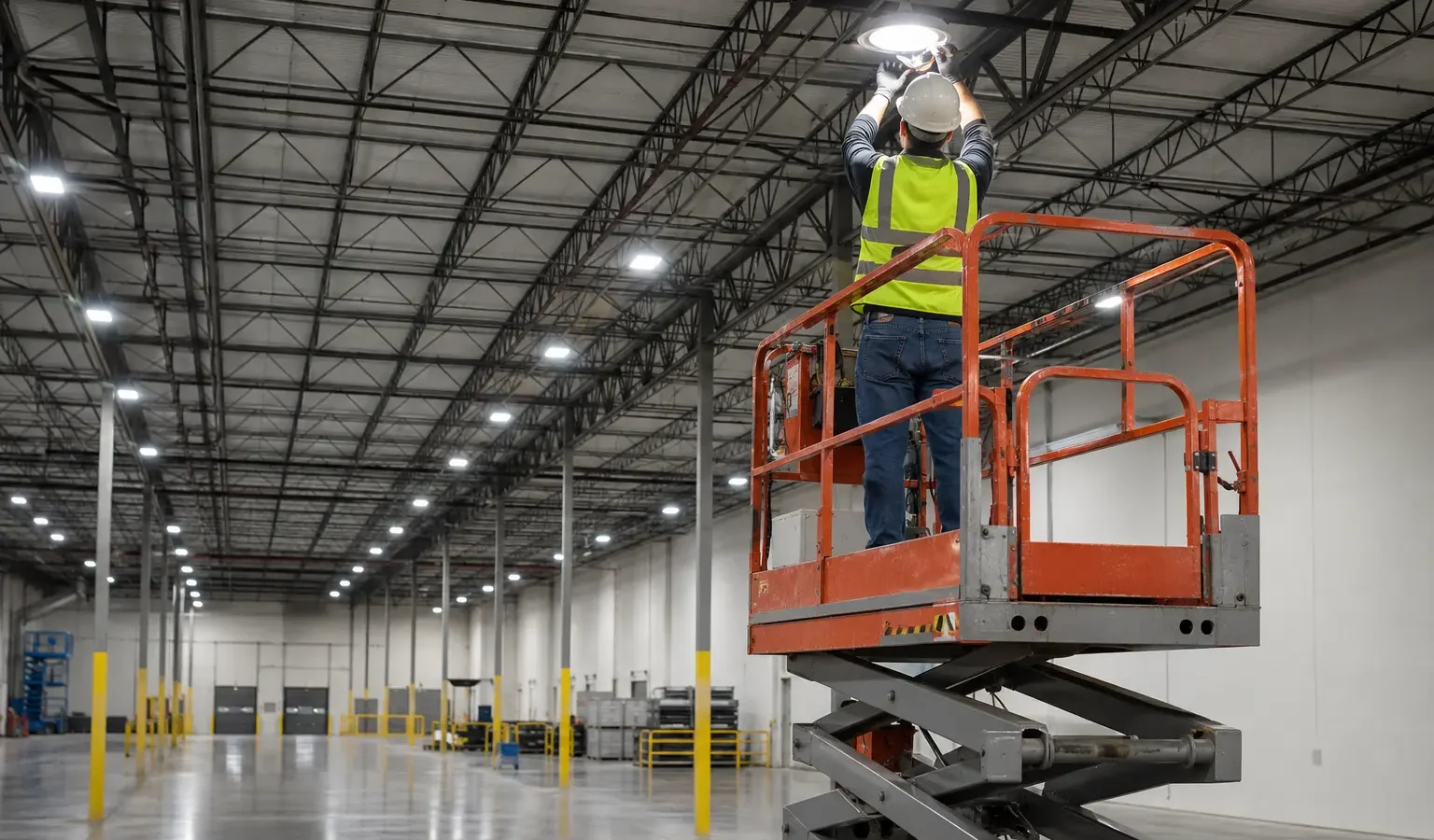
Commercial lighting needs investigation when fixtures are dark, flickering, cycling, dim, slow to start, discoloured, physically damaged, affected by controls, failing repeatedly, or no longer providing suitable coverage.
A symptom does not identify the cause. The same dark area could involve a lamp, driver, ballast, module, connection, sensor, control, circuit, obstruction, or changed layout. Diagnose the system before choosing repair or replacement.
Quick planning checklist
- Record exact location, symptom, quantity, timing, photos, height, access, and controls
- Check whether the issue is isolated, repeated, weather-related, schedule-related, or building-wide
- Identify fixture, lamp, driver, ballast, sensor, photocell, timer, and previous repair information
- Review parts, approvals, compatibility, condition, output, distribution, colour, and access cost
- Compare immediate repair with grouped replacement or retrofit options
- Document completed work, cause, remaining deficiencies, and future priority
Dark or intermittent fixtures
A completely dark fixture may have a failed source, driver, ballast, connection, socket, control, circuit, or power issue. Intermittent faults may appear with temperature, vibration, moisture, time, occupancy, or load. Record the pattern before service.
Flicker, cycling, and delayed start
Flicker can relate to lamps, ballasts, drivers, LED modules, connections, dimming compatibility, controls, voltage conditions, temperature, or equipment age. HID cycling and fluorescent start problems have different likely causes from an LED fixture that flashes when dimmed.
Reduced output or colour changes
Lenses can yellow or become dirty, lamps can depreciate, HID can shift colour, LEDs can lose output, drivers can underperform, and mixed replacements can create inconsistent appearance. Cleaning, components, fixtures, or a broader standard may be involved.
Physical damage, moisture, heat, or corrosion
Cracked lenses, loose doors, failed seals, water entry, corrosion, impact, heat, dust, insects, vibration, and unsuitable equipment can shorten life. Replacing the same component without correcting the condition may repeat the failure.
Sensors and schedules that behave incorrectly
Lights that remain on, switch off too soon, turn on at the wrong time, or control the wrong area may involve sensor coverage, timeouts, sensitivity, programming, photocells, time clocks, contactors, overrides, networks, or changed layouts.
Repeated high-access service
A repair may be inexpensive at the fixture but costly after lift delivery, work-zone control, aisle or parking closure, and disruption. Group known deficiencies and compare equipment family, parts, age, energy, controls, and future maintenance.
When replacement becomes more practical
Consider replacement when parts are obsolete, condition is poor, failures repeat, access dominates cost, the fixture no longer suits the area, controls are incompatible, colour is inconsistent, approvals are unclear, or an organized upgrade produces a better lifecycle outcome.
Questions to ask before approving the work
- What is the verified cause rather than the visible symptom?
- Has the same fixture, component, area, or equipment family failed before?
- Are parts available, approved, compatible, supported, and economical to install?
- Does the existing fixture still provide suitable output, distribution, colour, controls, and rating?
- How much of the service cost comes from lifts, access, closures, security, weather, and disruption?
- Should related deficiencies be grouped into a planned repair or retrofit phase?
Related services and facility guidance
Frequently asked questions
Does flicker always mean the fixture needs replacement?
No. The issue may involve a replaceable lamp, driver, ballast, connection, control, dimming compatibility, or supply condition. Diagnosis and component availability determine the response.
Can a dark area be fixed if every fixture works?
Possibly through layout, distribution, aiming, shielding, output, mounting, obstruction, task-lighting, or surface changes. The area needs review rather than a failure-only repair.
Should all fixtures of the same age be replaced after one failure?
Not automatically. Review failure rate, condition, parts, access, energy, consistency, controls, expected future work, budget, and operational risk. A grouped replacement may or may not be justified.
What records help future repairs?
Keep fixture and control model information, location, date, symptom, cause, parts, settings, access method, photos, completed work, warranty, and remaining deficiencies.
Primary Sources
Sources used for electrical, workplace, local, and incentive guidance
These primary sources support the material factual details on this page. Program information was reviewed July 24, 2026 and should be rechecked before a purchase, application, approval, or installation decision.
- Electrical Safety Authority: Notifications and InspectionsOntario guidance on notifications of work, inspections, and Licensed Electrical Contractors.
- Canadian Centre for Occupational Health and Safety: Lighting ErgonomicsWorkplace guidance on visibility, glare, shadows, contrast, task lighting, and fixture distribution.
Turn the guide into a site-specific plan
Use the facility, operating schedule, existing equipment, access, and priority areas to prepare a clear scope and written estimate.